Rumex venosus
Rumex alpinus
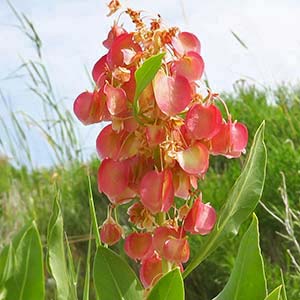
rumex veine, vein dock, veiny dock, wild-begonia, wing dock
alpine dock, butter dock, monk's-rhubarb, munk's rhubarb
ascending or, rarely, erect, usually producing axillary shoots near base, (10–)15–30(–40) cm.
erect, branched above middle, 60–100 cm.
blades ovate-elliptic, obovate-elliptic, or ovate-lanceolate, (2–)4–12(–15) × 1–5(–6) cm, subcoriaceous, base narrowly to broadly cuneate, margins entire, flat or slightly undulate, apex acute or acuminate.
ocrea mostly deciduous or sometimes partially persistent at maturity;
blade usually ovate-orbiculate, sometimes orbiculate or broadly ovate, 20–40 × 20–35 cm, base deeply and widely cordate, margins entire, flat or slightly undulate, apex obtuse.
terminal and axillary, usually occupying distal 2/3 of stem/shoot, usually dense, or interrupted in proximal part, broadly paniculate.
terminal, occupying distal 1/2 of stem, rather dense, widely paniculate to fusiform.
articulated near middle, filiform or slightly thickened, (8–)10–16 mm, articulation distinct, slightly swollen.
articulated at middle or in proximal 1/3, filiform, 3–9 mm, articulation distinctly swollen.
5–15 in whorls;
inner tepals distinctly double-reticulately veined, orbiculate or reniform-orbiculate, 13–18(–20) × (20–)23–30 mm, base deeply emarginate or cordate, margins entire, apex rounded, obtuse, rarely subacute, with short, broadly triangular tip;
tubercles absent, occasionally very small.
10–20 in whorls;
inner tepals ovate or ovate-triangular, 4–5(–6) × 3–5 mm, base truncate or slightly cordate, margins entire or subentire, apex obtuse or subobtuse;
tubercles absent.
brown or dark brown, 5–7 × 4–6 mm.
brown to brownish green, 2.5–3.5 × 1–2 mm.
= 40.
= 20.
Rumex venosus
Rumex alpinus
Rumex venosus is a distinctive species rarely confused with any other members of the genus. However, I have seen herbarium specimens of it misidentified as R. hymenosepalus, and vice versa.
(Discussion copyrighted by Flora of North America; reprinted with permission.)
Rumex alpinus belongs to subsect. Alpini Rechinger f. The name R. alpinus has been proposed for nomenclatural conservation (S. Cafferty and S. Snogerup 2000).
This species was first reported from North America in Nova Scotia (M. L. Fernald 1921; K. H. Rechinger 1937). It remains uncommon in the United States and Canada. Rumex alpinus never has been reported as being a serious invasive weed; however, it may persist at a site for a very long time. Previously, the species was cultivated widely, mostly for medicinal and veterinary purposes.
(Discussion copyrighted by Flora of North America; reprinted with permission.)
- Local floras:
 CA,
CA,  OR,
OR,  WA
WA - Local Web sites: CalFlora, CalPhotos,
 Flora NW,
  KS Wildflowers,
  MN Wildflowers,
  PNW Herbaria, Turner Photog.
  WildflowerSearch
 iNaturalist (observations)
 USDA Plants Database
- LBJ Wildflower Center
- SEINet
- Plants of the World Online
- Encyclopedia of Life
- Wikipedia
- Google Image Search
 Go Botany